AI in contact center helps align customer expectations, operational goals, and agent needs. When implemented thoughtfully, AI can streamline routine interactions, help agents resolve issues faster, improve quality and compliance, and turn conversation data into insights that drive better experiences.
Contact centers sit at the intersection of customer expectations and operational reality. Customers want quick, accurate, always-on support. Leaders want consistent quality, predictable costs, and clear performance visibility. Agents want tools that reduce repetitive work and make complex conversations easier. An omnichannel solution contact center ensures these goals are met across all channels, delivering a seamless experience for both customers and agents.
When evaluating solutions, understanding AI in contact center pricing is essential. Costs can vary depending on AI capabilities—such as chatbots, agent assist, predictive routing, and analytics—as well as the number of agents and total interactions. Having a clear view of pricing helps organizations plan effectively, scale AI initiatives without unexpected costs, and ensure that investments translate into measurable improvements in customer satisfaction, agent efficiency, and overall operational performance.
This guide breaks down what AI can do in a contact center, where it delivers the most value, and how to roll it out in a way that supports both customers and teams.
What “AI in the Contact Center” Means (In Practical Terms)
In contact centers, “AI” usually refers to a set of technologies that can understand language, predict intent, automate tasks, and generate helpful content. The goal is not to replace human support, but to reduce friction across the customer journey and augment agent performance—showcasing the impact of contact center ai technology.
These capabilities often include AI-based customer experience automation:
- Virtual agents and chatbots that handle common questions and guide customers through simple tasks.
- Agent assist that surfaces knowledge base articles, suggested next steps, or drafted responses during live interactions.
- Automatic transcription for calls, enabling searchable records and improved wrap-up.
- Conversation analytics that detect patterns, sentiment signals, and recurring issues across large volumes of interactions.
- Quality management automation that helps teams review more interactions with consistent criteria.
- Workforce optimization enhancements such as smarter forecasting inputs and more precise routing signals (depending on platform capabilities).
These tools can be deployed across channels such as voice, chat, email, messaging, and social support, reflecting the capabilities delivered by leading ai contact center companies and demonstrating why ai contact center solutions for enterprises are increasingly essential for modern customer service operations.
Why Contact Centers Are Ideal for AI
Contact centers generate high volumes of structured and unstructured data: call recordings, chat logs, ticket notes, dispositions, and outcomes. They also contain repeatable workflows: identity verification, order status checks, appointment scheduling, password resets, troubleshooting steps, and policy explanations.
AI performs particularly well when:
- Questions are frequent and follow known patterns.
- Agents need quick access to accurate information.
- Speed and consistency matter across large teams.
- Quality programs need scale beyond manual reviews.
The result is a powerful match: AI can help standardize and accelerate routine work while freeing humans to focus on nuance, empathy, and complex problem-solving.
Top AI in Contact Center Solutions
AI in contact centers uses machine learning, natural language processing, and automation to enhance customer interactions, improve agent efficiency, and reduce operational costs. These solutions allow enterprises to deliver consistent, personalized experiences across multiple channels while optimizing workflows. Here are some of the top AI contact center solutions:
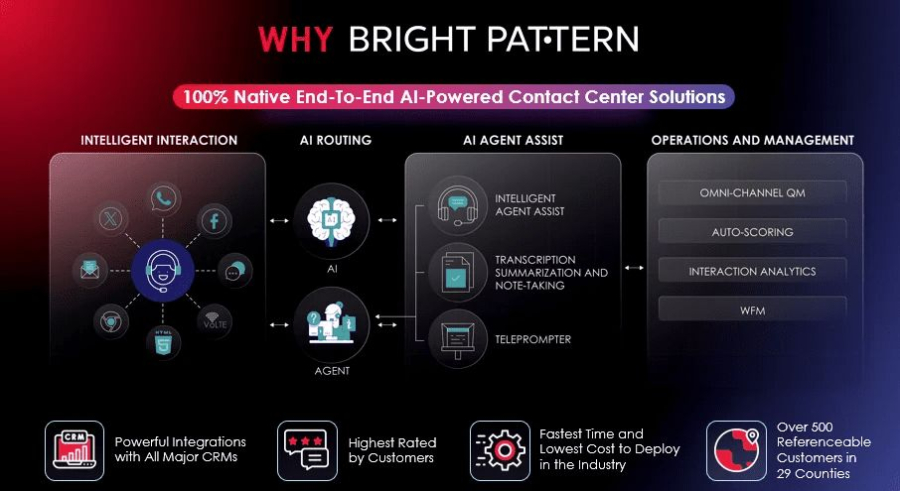
1. Bright Pattern — Enterprise AI Contact Center Platform

Bright Pattern provides a comprehensive AI contact center platform built for enterprises that need scalable automation, omnichannel engagement, and real-time agent assistance. Its technology helps businesses reduce operational costs, improve first-contact resolution, and enhance customer satisfaction.
Commercial Features and Benefits:
- Automated virtual agents handle routine inquiries such as billing questions, FAQs, order tracking, appointment scheduling, and returns, reducing agent workload.
- Intelligent routing connects customers to the right agent based on skills, sentiment, and history, improving efficiency and first-contact resolution.
- Omnichannel engagement unifies voice, chat, SMS, email, messaging apps, and video, maintaining conversation context across channels.
- Real-time agent assistance provides suggested responses, knowledge base articles, next-best actions, and sentiment analysis to improve agent accuracy and speed.
- Workflow automation streamlines repetitive tasks like ticket creation, follow-ups, notifications, and surveys.
- Predictive analytics tracks customer sentiment, interaction trends, and agent performance to optimize staffing and workflows.
- Integration with CRM systems, workforce management, and marketing platforms leverages existing technology investments.
- Proactive customer engagement allows automated notifications for service updates, delays, or promotions, reducing inbound contacts.
- Enterprise scalability and security ensure global compliance, data protection, and disaster recovery.
- Commercial ROI: Enterprises using Bright Pattern report reduced handling times, increased customer satisfaction, and lower operational costs, making it an ideal enterprise solution.
Bright Pattern is trusted by organizations across healthcare, finance, retail, and telecommunications for intelligent, automated, and customer-focused AI contact center solutions.
2. Genesys Cloud CX AI
Genesys Cloud CX provides AI-powered routing, predictive engagement, and analytics. Its platform allows enterprises to deliver proactive, personalized support while scaling operations efficiently.
3. NICE CXone AI
NICE CXone combines AI automation, workforce optimization, and quality management. It improves agent performance, reduces handle times, and delivers consistent service across multiple channels.
4. Talkdesk AI
Talkdesk provides AI-powered virtual agents, real-time agent assist, and automated workflows. Enterprises can streamline support operations, improve resolution times, and optimize staffing.
5. Amazon Connect AI
Amazon Connect leverages Amazon Lex and Contact Lens for AI-driven virtual agents, speech analytics, sentiment detection, and cloud-native automation to scale enterprise support.
6. Zendesk AI
Zendesk uses AI to automate ticket routing, provide conversational bots, and suggest knowledge base articles, helping teams resolve inquiries faster.
7. Microsoft Dynamics 365 AI
Microsoft Dynamics 365 delivers AI-assisted case routing, virtual agent support, and predictive insights, improving operational efficiency and customer experience.
8. Google Cloud Contact Center AI (CCAI)
Google CCAI provides AI virtual agent orchestration, real-time agent assistance, sentiment analysis, and speech-to-text analytics to optimize workflows and enhance customer interactions.
9. Salesforce Service Cloud + Einstein AI
Salesforce Einstein integrates AI into Service Cloud for intelligent case routing, predictive recommendations, workflow automation, and agent guidance, improving efficiency and customer satisfaction.
10. Five9 AI
Five9 provides AI-powered virtual agents, smart IVR, and real-time agent assistance, automating routine interactions and optimizing enterprise contact center operations.
High-Impact Use Cases (and the Benefits They Deliver)
1) Self-Service That Actually Resolves Issues
Modern virtual agents can do more than deflect. When designed around real customer intents and backed by reliable data sources, they can resolve common tasks end-to-end, such as:
- Checking order or case status
- Updating account information
- Scheduling or rescheduling appointments
- Answering policy and product questions
- Guiding basic troubleshooting
Benefits:
- 24/7 availability without adding overnight staffing.
- Shorter wait times by reducing demand on live queues.
- Consistent answers for frequently asked questions.
- Smoother peak handling during promotions, outages, or seasonal volume spikes.
When a handoff to an agent is needed, AI can pass context (customer intent, steps already tried, relevant account details) so customers do not have to repeat themselves.
2) Agent Assist for Faster, More Confident Resolutions
Agent assist tools can support agents during live interactions by surfacing relevant information and recommended actions in real time. This can include:
- Suggested knowledge base articles based on what the customer is saying
- Drafted replies for chat or email that agents can edit
- Reminders for required steps (verification, disclosures, escalation rules)
- Auto-summarization of prior interactions for fast context
Benefits:
- Reduced average handle time (AHT) by cutting search and typing time.
- Higher first-contact resolution (FCR) through better guidance and less guesswork.
- More consistent quality across agents and shifts.
- Improved onboarding as new agents rely on in-the-moment coaching.
In practice, the best results come when agent assist is tightly aligned with current policies and updated knowledge content.
3) Automated Transcription and Smarter After-Call Work
Manual note-taking and after-call work can add significant time and variability. AI transcription and summarization can help generate interaction records that are easier to review, search, and audit.
Benefits:
- Faster wrap-up with consistent summaries and next steps.
- Better continuity when cases are transferred or reopened later.
- Improved knowledge because patterns in calls and chats become more visible.
Summaries should be treated as drafts when stakes are high. Many teams set up workflows where the agent reviews and confirms key details before finalizing the record.
4) Conversation Analytics That Turn Interactions into Action
Contact centers often contain the earliest signals of product issues, policy confusion, website friction, and customer sentiment shifts. AI can help analyze large volumes of interactions to identify:
- Top drivers of contact
- Emerging spikes in specific issues
- Recurring “where customers get stuck” moments
- Coaching opportunities based on patterns
Benefits:
- Faster root-cause identification so teams can fix upstream problems.
- Better product and policy feedback loops driven by real customer language.
- More targeted training based on what’s actually happening in conversations.
When analytics insights are shared with product, operations, and digital teams, contact centers become a strategic engine for experience improvement.
5) AI-Enhanced Quality Management at Scale
Traditional quality programs often sample a small percentage of interactions. AI-assisted quality management can help teams review more interactions consistently by automatically flagging:
- Calls or chats that include certain phrases or risk indicators
- Interactions where a required disclosure may be missing
- Moments of escalation or repeated customer effort
Benefits:
- Broader coverage than manual sampling alone.
- More consistent scoring when aligned to clear criteria.
- Faster coaching cycles by focusing on the highest-impact moments.
Many teams pair AI flagging with human review for final decisions, especially in regulated environments.
Where AI Typically Delivers the Biggest ROI
The best ROI usually comes from combining customer-facing automation with agent-facing augmentation, supported by strong knowledge management. Below is a practical map of where value often appears.
| AI capability | Best for | Value outcomes teams often target |
|---|---|---|
| Virtual agents (chat / voice) | High-volume, repeatable requests | Lower queue load, faster response, 24/7 coverage |
| Agent assist | Complex product sets and policy-heavy support | Reduced AHT, improved FCR, faster onboarding |
| Transcription and summarization | Voice-heavy environments and case continuity | Less after-call work, clearer records, easier audits |
| Conversation analytics | Identifying top contact drivers and trends | Root-cause fixes, improved customer journey, fewer repeat contacts |
| AI-assisted quality | Scaling QA and compliance monitoring | More consistent quality, targeted coaching, risk reduction |
Success Stories (Patterns You Can Replicate)
Not every contact center is the same, but successful AI rollouts tend to follow repeatable patterns. Here are examples of outcomes that teams commonly achieve when they focus on the right foundations and use cases.
Pattern A: Self-Service + Smart Handoff Reduces Repeat Contacts
A customer support team introduces a virtual agent for the top intents (such as order status and appointment changes) and ensures that when the customer needs a human, the agent receives the transcript and structured context. Customers get faster answers for simple needs, and agents spend more time on complex issues.
Why it works: it improves speed without sacrificing continuity, which is a major driver of customer satisfaction.
Pattern B: Agent Assist Standardizes Answers Across a Growing Team
A fast-growing business struggles with inconsistent answers as new agents ramp. Agent assist is deployed to surface approved knowledge and draft responses. Supervisors update knowledge content in one place, and agents see improvements immediately.
Why it works: it reduces dependence on tribal knowledge and helps new hires perform like experienced agents sooner.
Pattern C: Analytics Reveals the Real Drivers of Contact
Conversation analytics identifies that a large share of contacts are driven by confusion about a specific billing description and a web checkout step that fails for some devices. Fixes outside the contact center reduce demand and improve the customer journey.
Why it works: it treats the contact center as a source of customer intelligence, not just a cost center.
How to Implement AI in a Contact Center (A Practical Roadmap)
Step 1: Pick Use Cases with Clear Success Metrics
AI initiatives move faster when tied to measurable outcomes. Useful metrics depend on the use case, but often include:
- Containment rate (for self-service): how often the virtual agent resolves the issue without an agent.
- Average handle time (AHT): time per interaction, including after-contact work.
- First-contact resolution (FCR): how often issues are solved without follow-up.
- Customer satisfaction (CSAT) or post-contact survey results.
- Quality scores and evaluation consistency.
- Agent experience indicators such as time to proficiency and internal satisfaction.
Start with one or two high-volume, well-defined journeys so you can learn quickly and prove impact.
Step 2: Strengthen Knowledge and Data Foundations
AI is only as reliable as the information it can access. Strong foundations typically include:
- A well-maintained knowledge base with clear ownership and review cadence
- Consistent tagging of contact reasons and outcomes
- Clean integration paths for CRM, order systems, and case management (where applicable)
- Defined policy and compliance language where required
Improving knowledge content often boosts performance even before AI is added, and it amplifies the impact once AI is deployed.
Step 3: Design for the Agent and Customer Experience
High-performing contact center AI is designed around real conversation flows:
- Make it easy to reach a human when needed.
- Use clear, customer-friendly language.
- Capture key context early (without making the customer repeat themselves later).
- For agent assist, keep suggestions concise and actionable.
Small UX choices can drive adoption more than advanced features.
Step 4: Put Governance and Safety Checks in Place
To keep AI outputs dependable, teams typically define:
- What AI is allowed to do (and what requires an agent).
- Approval workflows for knowledge updates and policy changes.
- Privacy and data handling rules for transcripts, recordings, and stored summaries.
- Monitoring processes for drift in performance as customer needs change.
This keeps customer trust high while supporting compliance requirements.
Step 5: Train, Pilot, and Iterate
The most effective rollouts treat AI as a program, not a one-time launch:
- Pilot with a subset of intents or a small agent group.
- Collect agent feedback on what helps and what distracts.
- Review customer outcomes and tune workflows.
- Expand gradually with a documented playbook.
Iteration is where AI value compounds, because every improvement affects a large volume of interactions.
What to Prioritize First: A Simple Decision Guide
If you are deciding where to begin, the following sequence is often effective:
- Top customer intents that are high-volume and low complexity (ideal for self-service).
- Agent assist for the top 10 to 20 knowledge articles used most frequently (fast productivity gains).
- Transcription and summarization to reduce after-contact work (immediate time savings).
- Analytics and quality scaling to improve coaching and uncover root causes (strategic impact).
This path builds momentum and makes it easier to fund larger phases with demonstrated results.
Key Takeaways
- AI in the contact center can improve speed, consistency, and customer satisfaction while making agent work more efficient and rewarding.
- The strongest outcomes come from pairing automation (virtual agents) with augmentation (agent assist), supported by reliable knowledge and data.
- Success is driven by clear metrics, thoughtful experience design, and ongoing iteration.
When you treat AI as a practical set of tools to remove friction from customer conversations, the contact center becomes more than a support function. It becomes a scalable, insight-driven experience engine that strengthens loyalty, productivity, and long-term growth.
